
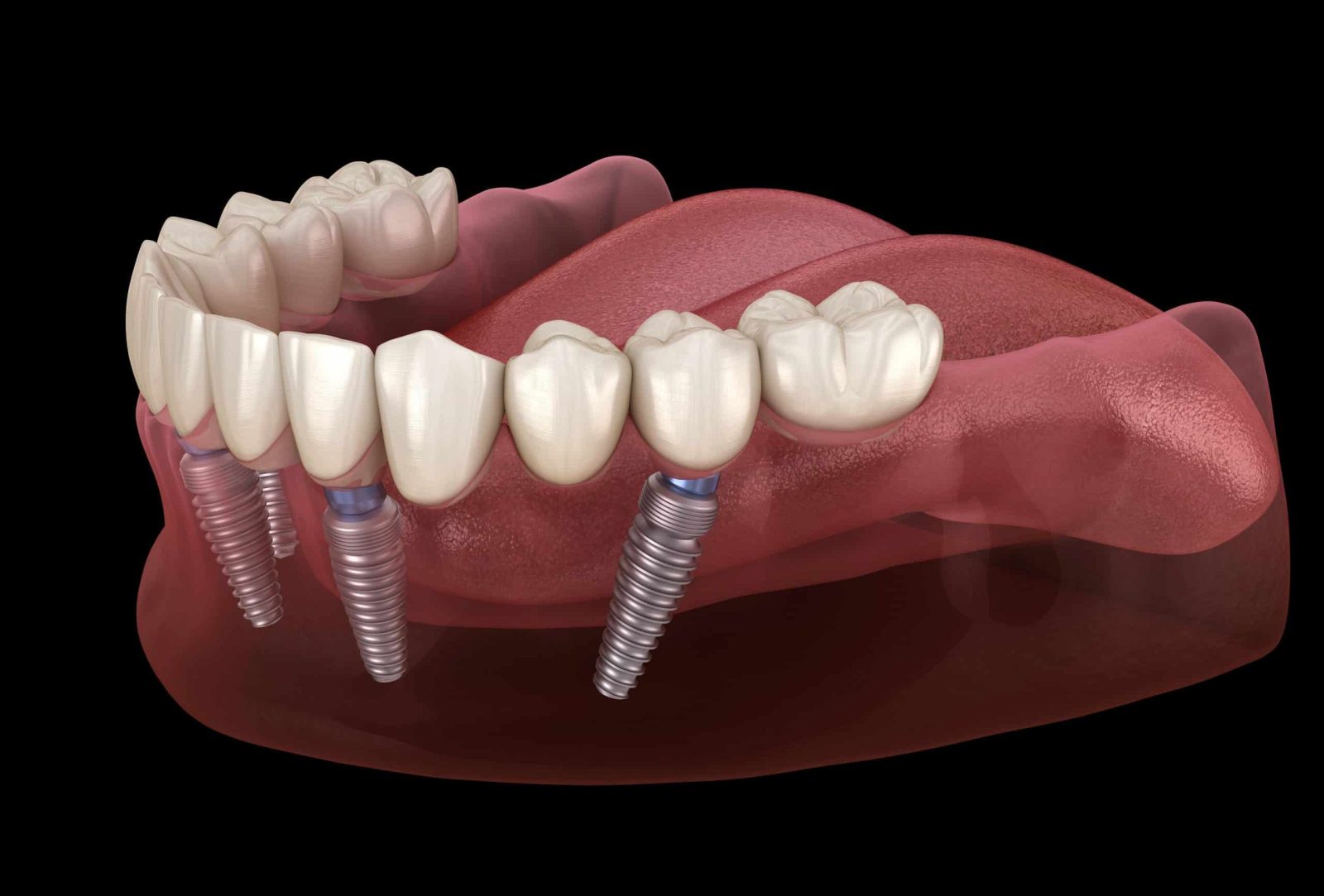
When you start researching full-arch dental implants, you’ll see terms like All-on-4, All-on-6 and All-on-X. It’s natural to wonder: is more implants always better? Do I need four or six? And who decides?
At The Dental Center of Jefferson in Lake Hopatcong, Dr. Mostafa Jabr plans every full-arch case individually. Here’s a clear explanation of the difference between All-on-4 and All-on-6, and how we decide how many implants are right for you.
What Do All-on-4, All-on-6 and All-on-X Mean?
All three replace a full arch of upper or lower teeth with a fixed bridge supported by dental implants. The number refers to how many implants hold the bridge:
- All-on-4: four implants support a full arch. The two back implants are usually placed at an angle to make the most of available bone.
- All-on-6: six implants support a full arch, spreading chewing forces across more points.
- All-on-X: the umbrella term. The “X” means the number of implants is chosen for each patient, whether that’s four, five, six or more.
Whatever the number, the goal is the same: a strong, stable, natural-looking set of teeth that stays in place.
How All-on-4 Works
All-on-4 was designed to give patients fixed teeth with as few implants as possible. By angling the back implants, we can often avoid the sinuses in the upper jaw and the nerve in the lower jaw, and use longer implants anchored in denser bone. For many patients, this means avoiding bone grafting.
Often a good fit when:
- Bone is limited in the back of the jaw
- You want to avoid or minimize grafting
- Your bone in the front of the jaw is strong and healthy
- Your bite forces are moderate
How All-on-6 Works
All-on-6 adds two more implants, so chewing forces are shared across six support points instead of four. More support can mean less stress on each implant and the bridge.
Often a good fit when:
- Bone is softer, which is common in the upper jaw
- You have a strong bite or grind and clench
- There’s enough bone to place additional implants safely
- Extra support adds a margin of safety for your case
All-on-4 vs. All-on-6 at a Glance
| All-on-4 | All-on-6 | |
|---|---|---|
| Number of implants | 4 | 6 |
| Implant angle | Back implants usually angled | Often more upright |
| Bone needed | Can work with less bone | Needs enough bone for more implants |
| Bone grafting | Often avoided | Sometimes needed |
| Force distribution | Shared across 4 implants | Shared across 6 implants |
| Best suited for | Limited bone, moderate bite | Softer bone, strong bite, grinders |
How We Decide How Many Implants You Need

There’s no one-size-fits-all number. Dr. Jabr bases the decision on:
- Your 3D CBCT scan. It shows the height, width and density of your bone, plus the location of your nerves and sinuses.
- Upper vs. lower jaw. The upper jaw typically has softer bone and the sinuses limit space in the back, so it may benefit from more support.
- Your occlusal scheme and bite force. How your teeth come together, and whether you grind or clench, affects how much force each implant carries.
- What you’re biting against. Natural teeth, a denture or another implant bridge each create different forces.
- Your health. Smoking, diabetes control, vitamin D and medications all affect healing and long-term stability.
- Your bridge design. The size and shape of your final teeth affect how forces are distributed.
More implants aren’t automatically better, and fewer aren’t automatically riskier. The right number gives you a stable result with the least invasive surgery possible. We’ll explain our reasoning so you understand exactly why we recommend your plan.

Does the Number of Implants Affect Teeth-in-a-Day?
Same-day teeth depend on how firmly the implants are anchored on surgery day, whether there are four or six. When the implants are stable enough, you can leave with fixed temporary teeth. Learn more in our guide to what really happens on Teeth-in-a-Day.
What About the Final Teeth?
Your final bridge material is a separate decision. At our office, zirconia and acrylic final bridges are the same price, and Dr. Jabr selects the best material for your bite. Read our comparison of zirconia vs. acrylic All-on-4 teeth.

All-on-4 vs. All-on-6 FAQs
Is All-on-6 better than All-on-4?
Not automatically. Both can give excellent long-term results. All-on-6 spreads chewing forces across more implants, which can help with softer bone or a strong bite, while All-on-4 can make the most of limited bone with fewer implants. The best choice depends on your anatomy and bite.
Can I get All-on-4 if I’ve lost a lot of bone?
Often, yes. All-on-4 angles the back implants to use the strongest available bone, which can help many patients avoid bone grafting. A 3D CBCT scan will show what’s possible for you.
Why might the upper jaw need more implants?
The upper jaw usually has softer bone than the lower jaw, and the sinuses limit how much bone is available in the back. For that reason, some upper arches benefit from additional implants for added support.
What happens if one implant fails?
With any full-arch design, a failed implant can usually be replaced after the area heals. Having extra implants can add a margin of support, which is one reason we may recommend more implants for certain patients.
Do I get to choose the number of implants?
We’ll always explain your options and our reasoning. Dr. Jabr recommends the number of implants that gives you the safest, most stable long-term result based on your scan, bite and health.
Find Out Which Option Is Right for You
The only way to know how many implants you need is a consultation and 3D scan. Call The Dental Center of Jefferson at (973) 663-4220 to schedule your visit with Dr. Jabr. We welcome patients from across Sussex, Morris and Warren counties. You can also read about All-on-4 cost and the treatment process, or visit our All-on-4 dental implants and dental implants pages.
About the author: Dr. Mostafa Jabr, DMD, is a general and restorative dentist and the owner of The Dental Center of Jefferson in Lake Hopatcong, NJ, where he helps patients from across North Jersey restore their smiles with dental implants and full-arch treatment.
This article is for general education and isn’t a substitute for a personal exam. Every patient’s situation is different.